Roots of Abundance - A Regenerative Breadfruit Forests Initiative
By JungleProjectAbout This Project
Introduction to the Metaproblem
Globally, food insecurity, climate change, land degradation, and biodiversity loss are converging crises that threaten both human well-being and the health of entire ecosystems.
The way we grow, trade, and consume food is one of the primary drivers of these challenges.
Conventional agriculture. optimized for higher production at lower costs. has led to:
- Widespread deforestation and biodiversity loss
- Soil degradation and disrupted water cycles
- Human rights abuses and economic precarity for farming communities
- Food systems that often fail to nourish human health, contributing to rising malnutrition and chronic disease
Today’s agricultural markets reward extraction over regeneration.
If we want an economy that restores rather than depletes, we must intentionally design for it.
A truly regenerative food system must:
- Be built with producer communities
- Center farmers as key stakeholders and decision-makers
- Ensure that value flows back to those stewarding land, biodiversity, and ecosystems
The challenge before us is not simply to grow more food, but to redesign the economic systems that govern how food is produced, distributed, and valued, so they nourish both planetary and human health, in harmony with the living systems that sustain all life.
Core Problem in the Bioregion
What’s happening on the ground
In Costa Rica and the Dominican Republic — two of the world’s most important biodiversity hotspots — industrial monocultures dominate agriculture.
Crops such as banana, cacao, pineapple, and palm oil are widely grown in systems that:
- Clear forests
- Erode soils
- Disrupt water cycles
- Undermine long-term livelihoods
These extractive patterns leave:
- Ecosystems depleted
- Communities economically vulnerable
- Local food systems unable to sustain either people or the planet. despite the region’s natural abundance
Proposed Solution
Redesigning food economies as living systems
This project proposes a fundamental redesign of food economies treating them as regenerative ecosystems that foster:
- Ecological restoration
- Community empowerment
- Human nourishment
- Equitable value distribution
From farm → market → consumer health, the goal is to demonstrate how food economies can be structured to regenerate land, strengthen communities, and share prosperity across the entire system.
Partnership
A systems-level collaboration
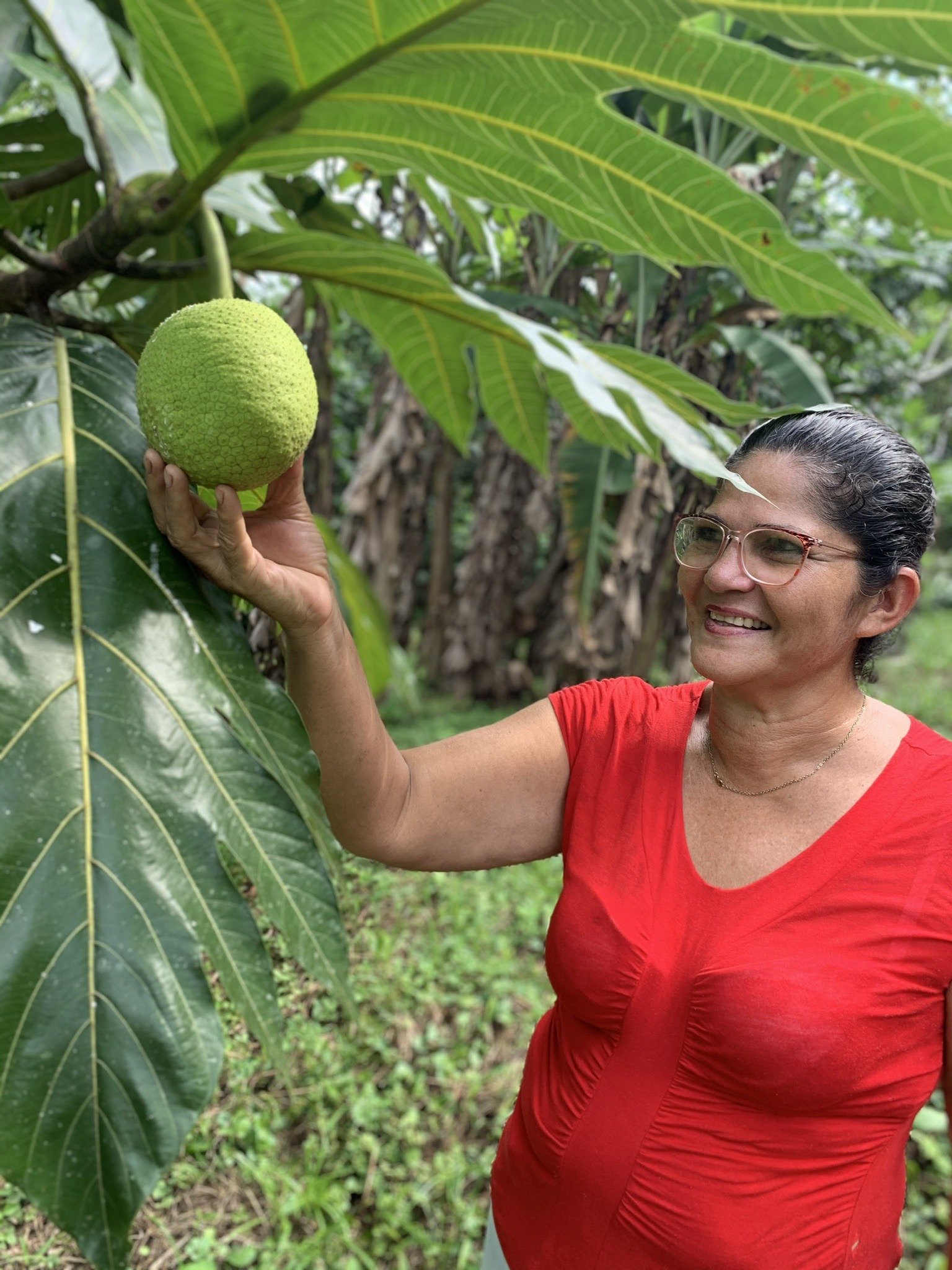
reNourish Studio and Jungle Project have partnered to develop the Breadfruit Economy Ecosystem a systems-wide initiative centered on breadfruit (Artocarpus altilis), a resilient and nutrient-rich tropical crop.
This collaboration builds on:
- Jungle Project’s 10+ years of work with farmers in Costa Rica and the Dominican Republic
- The establishment of breadfruit agroforestry systems as alternatives to monoculture farming
Together, the partners are designing a new regenerative supply system model that balances:
- Ecological health
- Community well-being
- Market viability
Breadfruit’s Regenerative Potential
Breadfruit provides a powerful foundation for regenerative food system design through its ecological, nutritional, and climate-resilient qualities.
Ecological Regeneration
Breadfruit thrives in diverse agroforestry systems that:
- Restore soil health
- Enhance biodiversity
- Support water cycles
- Sequester carbon
It offers a practical pathway away from degenerative monocultures toward living landscapes and resilient livelihoods.
Nutritional Value
Breadfruit is:
- High in fiber
- Rich in complex carbohydrates
- Packed with essential minerals
It meets growing demand for gluten-free, grain-free, and plant-based foods that support long-term human health.
Climate Resilience
As a perennial, low-input crop, breadfruit:
- Reduces reliance on chemically intensive staples like wheat, corn, and rice
- Strengthens local food sovereignty
- Provides a stable, climate-resilient food source
Market Opportunity
Breadfruit can be transformed into:
- Flour
- Pasta
- Baked goods
- Clean-label, plant-based products
Its versatility positions it strongly within health-driven and sustainability-focused markets.
With both regenerative and nutritional value, breadfruit represents a strategic cornerstone crop for building a values-driven food economy that benefits:
- Farmers
- Businesses
- Consumers
- Ecosystems
The Economy Ecosystem Model
The Breadfruit Economy Ecosystem envisions an integrated network of:
- Farmers
- Processors
- Manufacturers
- Brands
- Retailers
…working collaboratively to regenerate ecological and economic systems.
The model prioritizes:
- Shared value & inclusive governance
- Regenerative design across every supply-chain stage
- Empowered local communities and resilient markets
Initial implementation will take place in Costa Rica and the Dominican Republic, where transitioning away from extractive monocultures can:
- Restore ecosystems
- Strengthen rural livelihoods
- Establish new standards for ethical, regenerative supply chains
What Makes This Unique
Unlike conventional agricultural projects, the Breadfruit Economy Ecosystem integrates:
- Ecological design
- Enterprise development
- Community empowerment
…into one unified framework.
It treats the food economy as a living system mapping relationships from soil to market and aligning them for regeneration.
This model is replicable across crops and regions, offering a blueprint for global food system transformation.
Crucially, it builds equitable market pathways through:
- Farmer-owned enterprises
- Local cooperatives
Ensuring that value remains within the communities growing the food.
Why Your Support Matters
Your contribution directly supports the creation of a regenerative food economy.
This is not just about planting trees or launching a single product.
It is about:
- Funding research and systems design
- Building farmer-centered partnerships
- Developing regenerative infrastructure
- Demonstrating a scalable model for climate resilience and nourishment
Supporting this project means investing in a future where:
- Agriculture restores ecosystems
- Local economies thrive
- Food systems promote global food sovereignty
Call to Action
Join the food systems evolution
This initiative is more than a regenerative agriculture project, it is a food systems evolution.
With your support, breadfruit can become a global catalyst for:
- Ecological regeneration
- Human health
- Economic justice
Donate now and help build a future where food truly nourishes people and the planet.
Thank you for being part of this transformation.
Project Impacts
No Sustainable Development Goals linked yet.
Regenerative System Design & Farmer Alignment

Agroforestry Expansion & Farm Transition
Milestone Description:
This milestone supports the on-the-ground transition from extractive monocultures to regenerative breadfruit agroforestry systems.
Key activities include:
- Expansion of breadfruit planting within diversified agr
Processing Infrastructure & Value Addition
Milestone Description:
This phase enables local value creation by developing processing capacity for breadfruit products, ensuring farmers benefit beyond raw commodity sales.
Key activities include:
- Small-scale processing equipment a
Market Development & Product Pilots
Milestone Description:
This milestone focuses on connecting regenerative production to viable markets through product development and strategic partnerships.
Key activities include:
- Product formulation and testing (flour, pasta, bake
Impact Measurement, Scaling & Replication Framework
Milestone Description:
The final milestone consolidates learning, measures impact, and prepares the model for scaling and replication across regions and crops.
Key activities include:
- Impact measurement across ecological, social, and
JungleProject

Mission
To partner with rural communities to regenerate livelihoods and the environment through agroforestry.
Support This Project
.jpg?alt=media&token=81e7a811-b9f8-4b18-a135-260403af049a)